
Fencing
Vinyl vs. Wood Fence: Which Holds Up Better in Hampton Roads?
Vinyl or wood is the first real decision in a privacy fence project, and it is the one homeowners get the least help with. Search it and you will find the same four points repeated everywhere: wood is cheaper, vinyl lasts longer, wood needs staining, vinyl does not. All true, all national, and none of it answers the question for a yard in Virginia Beach.
Divine Touch Home Improvements is based in Virginia Beach and has installed and repaired fences across Virginia Beach, Chesapeake, Norfolk and Portsmouth since 2019. What decides this choice here is not the material brochure. It is sandy soil, a water table that sits high in low-lying yards, salt air that eats hardware before it touches the fence boards, and the wind that comes with every nor'easter. This guide covers all of that, with real installed cost ranges and honest lifespans, so you can pick once and not think about it again for twenty years.
The Short Answer
Here is the comparison in one place. Each row is explained below.
| Wood privacy fence | Vinyl privacy fence | |
|---|---|---|
| Installed cost per linear foot | Roughly $25 to $50 nationally; pressure treated pine runs at the low end | Roughly $30 to $60 nationally |
| Realistic lifespan | About 10 to 15 years for pressure treated pine, 15 to 25 for cedar | About 20 to 30 years or more |
| Salt air | Boards are fine; hinges, latches and fasteners are the weak point | Panels are unaffected; hinges, latches and fasteners are still the weak point |
| Sandy soil and high water table | Posts sit in the ground and rot from the base up if drainage is wrong | Posts are usually wood or steel inside a vinyl sleeve, so the same rule applies |
| Storm wind | Boards can be replaced one at a time after damage | Panels are rigid; a damaged panel is replaced whole and has to be matched |
| Upkeep | Sealing or staining every few years, more on south and west runs | An occasional wash |
| Repairs | Any carpenter can match a picket | Color and profile have to be matched to the original product |
If you want the decision in one sentence: wood costs less today and is easier to repair, vinyl costs more today and asks less of you for the next two decades. Everything else is about your particular yard.
What Each One Actually Costs, and How Long It Lasts
Most comparisons stop at "wood is cheaper." That is not useful when you are trying to budget. Here are national installed ranges for a standard six foot privacy fence, which is what the great majority of Hampton Roads backyards get. These are market ranges, not a quote, and your yard will land somewhere inside them based on the factors further down.
| Material | Installed, per linear foot | Realistic lifespan |
|---|---|---|
| Pressure treated pine | About $15 to $30 | 10 to 15 years |
| Cedar | About $25 to $55 | 15 to 25 years |
| Vinyl (PVC) | About $30 to $60 | 20 to 30 years or more |
Put a real yard against those numbers. A 150 foot run of six foot privacy fence works out to roughly $3,750 to $7,500 in wood and roughly $4,500 to $9,000 in vinyl at the national ranges above. The gap is real but it is smaller than most people expect, and it narrows further once you account for staining a wood fence two or three times over its life.
Now divide by years. Pressure treated pine at the middle of its range, replaced at year twelve, and vinyl at the middle of its range, still standing at year twenty five, end up remarkably close per year of service. That is the honest way to compare them. The reason to choose wood is rarely that it is cheaper over the long run. The reason to choose wood is that it costs less to put in this year, it looks the way a lot of people want a backyard to look, and a damaged section is a cheap and quick fix.
Salt Air Goes After the Hardware, Not the Fence
This is the point that almost every national article misses. People close to the Oceanfront, along the bay, or near the inlets ask us whether salt air will ruin a wood fence or a vinyl one. The honest answer is that it will not do much to either. Vinyl panels do not corrode. Wood boards weather, but salt is not what finishes them.
What salt air does destroy is every piece of metal in the fence. Hinges, latches, drop rods, screws, nails and bracket plates. We have gone back to fences four and five years old where the boards were still sound and the gate had dropped because the hinges had rusted through from the inside. On a basic zinc coated hinge near the water, that is a normal outcome.
So the material question and the hardware question are separate, and the second one matters more than the first. On coastal runs we specify stainless or heavy galvanized hinges and latches rather than standard zinc plated hardware. The cost difference across a whole fence is small. The difference in how the gate feels at year seven is not. If you take one thing from this article, take that: ask whoever builds your fence what grade of hardware is in the scope, in writing, whichever material you pick.
The same logic runs through our coastal roofing comparison, where the flashing and fasteners outlast or undercut the roof itself for exactly the same reason.
Sandy Soil, High Water Table, and Why Posts Decide Everything
A fence does not usually fail at the boards. It fails at the posts, and in Hampton Roads the ground is the reason.
Our soil is sandy, which is easy to dig but holds a post less tightly than dense clay. In the low-lying parts of Norfolk, Portsmouth and the older sections of Virginia Beach, the water table can sit high enough that a post hole starts filling before the post goes in. Both conditions push in the same direction: the footing has to be sized and drained for the ground it is going into, not dug to a habit.
Here is the part that surprises people about vinyl. A vinyl privacy fence is not vinyl all the way down. The posts are commonly a wood or steel core inside a vinyl sleeve, or a hollow vinyl post set in concrete. Either way there is something in the ground that can rot or corrode if water is allowed to sit against it. Choosing vinyl does not exempt you from the soil conversation. It just hides it.
What we do about it is unglamorous and it is the whole job: footings sized to the fence height and post spacing rather than a standard hole, extra depth where the water table is high, gravel at the base of the footing so standing water drains away from the post instead of pooling against it, and real cure time for the concrete before any framing load goes on. A fence rushed through cure looks identical on handover day and leans by the second winter.
We also file the Virginia 811 locate before any digging so gas, water, cable and electric are marked, and we plan post spacing around whatever cannot be moved. That takes a few business days and it is built into the schedule from the start.
Wind, Nor'easters and the Style You Choose
A six foot privacy fence is a sail. That is not a figure of speech, it is the engineering problem. Boards set edge to edge give you full visual privacy and hand the wind a solid surface to push on, and in an exposed coastal yard that load goes straight into the posts and footings.
If your lot is open, backs onto water, or catches the wind off a field or a marsh, consider shadowbox instead of a solid privacy panel. Shadowbox alternates boards on opposite sides of the rails. You still get privacy at any normal viewing angle, air passes through the fence line, and the wind load on the posts drops. It is one of the most useful recommendations we make and almost nobody asks for it by name.
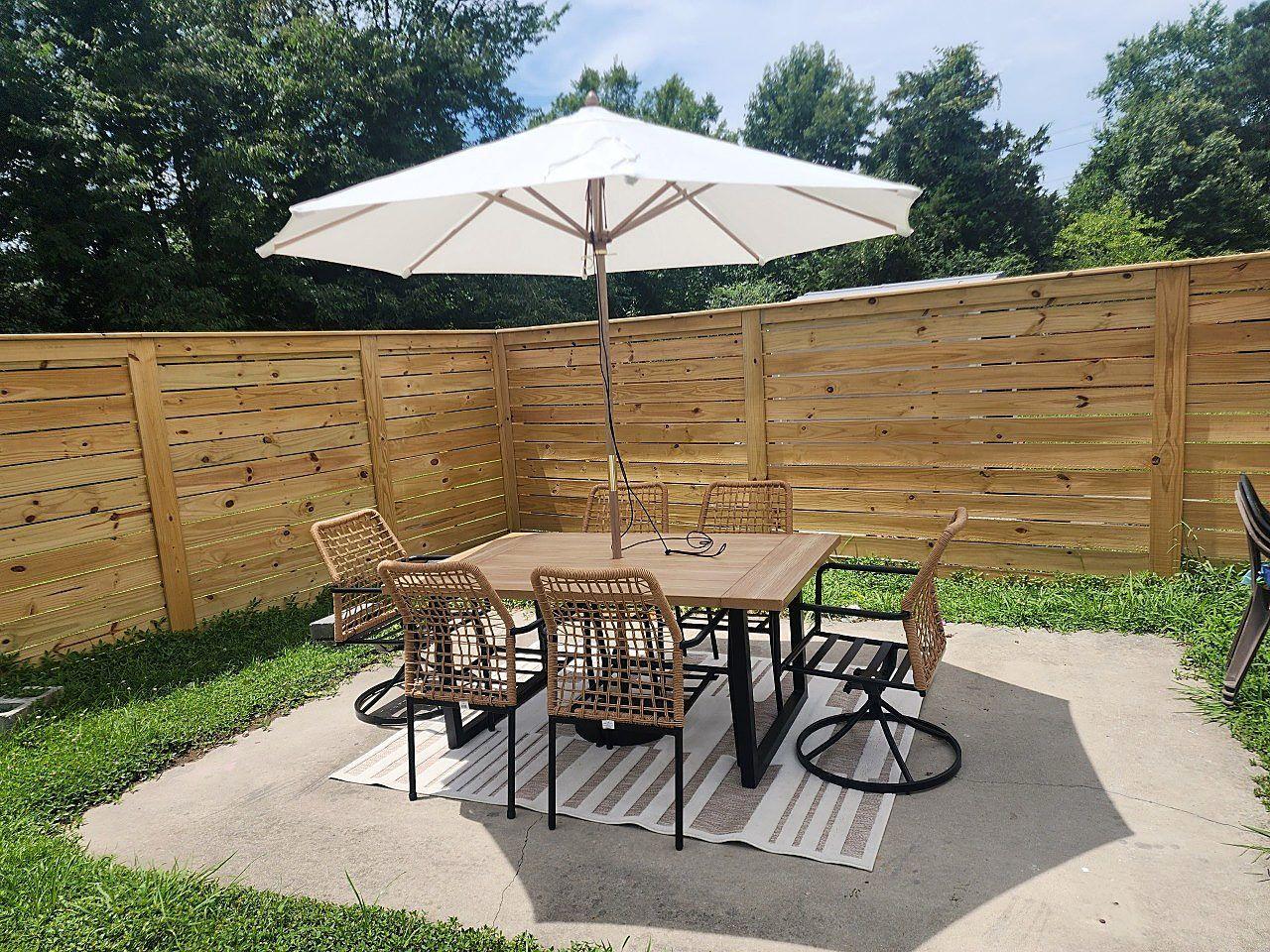
Horizontal board fencing, which has become popular here and is what you see in the photo at the top of this article, looks excellent and needs closer post spacing or added blocking to stay rigid over a long run. That is a design decision with a cost attached, and it should be settled before material is ordered rather than discovered halfway down the fence line.
After a storm the two materials behave differently. A wood fence that loses boards is patched in an afternoon with material from any lumber yard. A vinyl fence usually rides out wind well because the panels are rigid, but a panel that does crack is replaced whole, and the color and profile have to match a product that may have been discontinued. Neither is better. They are different kinds of inconvenience, and it is worth knowing which one you would rather have.
Upkeep, Looks and Living With It
A wood fence in this climate wants sealing or staining every few years, and the south and west facing runs will always need it first because they take the most sun. Skip it long enough and pressure treated pine will warp, check and grey out. Some homeowners like the weathered grey and let it go, which is a legitimate choice as long as you accept the shorter life that comes with it.
Vinyl asks for a wash. That is the whole maintenance program. The trade-off is that what you install is what you have, permanently. You cannot restain a vinyl fence in a different color five years later because you repainted the house. Wood you can.
On the cold brittleness point that comes up in every national comparison: vinyl can become brittle in extreme cold, and that is genuinely not a Hampton Roads problem. Our winters do not get there. Do not let it weigh on the decision here.
One more thing people only think about afterwards. Wood goes up fast and looks new and sharp on day one, then settles into its character. Vinyl looks exactly the same on day one and on day eight thousand. Whether that is the appeal or the drawback is genuinely a matter of taste, and it is worth deciding before you are standing in front of a finished fence.
Which One We Would Put in Your Yard
Enough hedging. Here is how we actually advise people, based on the yard rather than the brochure.
- Choose wood if the budget this year is the binding constraint, if you want a horizontal or custom style that vinyl does not offer, if you expect to move within ten years, or if you like the idea of being able to change the color later.
- Choose vinyl if this is your long-term home, if you know you will not keep up with staining, if the fence runs somewhere awkward to maintain such as behind a pool or a dense planting bed, or if you simply want to stop thinking about the fence.
- Choose shadowbox in either material if your lot is open or exposed to wind off the water.
- Spend the money on hardware either way if you are anywhere near the Oceanfront, the bay or the inlets. Stainless or heavy galvanized hinges and latches on every gate.
- Do not choose on lifespan alone. A vinyl fence on poorly drained posts will fail before a wood fence on properly drained ones. The ground beats the material every time.
How Divine Touch Can Help
We are a veteran-owned, family-owned and minority-owned company based in Virginia Beach, and we work in English and Spanish. We walk the yard with you first, talk through where the property line sits and what your HOA expects, and put the material, the style, the hardware grade and the gate widths in a written scope before anything is ordered. We take care of the HOA submission and any city paperwork as part of that scope, so it is handled rather than left with you.
See our fence services, the work we have completed across Virginia Beach, or request an estimate time and we will confirm within one business day. You can also call (757) 731-4151.